
Ever stood before a swirl of vibrant color and bold lines, feeling a rush of emotion but unsure what it all means? This feeling is the magic at the heart of the world’s most famous abstract paintings. These masterpieces weren’t made to be ‘solved’ like a puzzle; they were created to be felt. They are a celebration of pure color, shape, and emotion, designed to speak directly to the soul, bypassing the need for a recognizable subject.
In this guide, we celebrate ten iconic works that forever changed the art world. We’ll unlock the secrets to their power and show you how to channel that same vibrant, expressive energy into your own space. Get ready to move past intimidation, discover the confidence to choose art you love, and find the perfect piece to make your home feel more alive, more stylish, and more you.
Key Takeaways
- Discover how abstract art moves beyond recognizable subjects to express powerful emotions and ideas.
- Uncover the revolutionary stories behind famous abstract paintings and the artists who dared to redefine art itself.
- Find your personal style by exploring diverse movements, from the early pioneers to bold Abstract Expressionism.
- Turn inspiration into action with practical tips on selecting and styling vibrant abstract art to elevate your home.
What is Abstract Art? A Journey Beyond the Visible World
Imagine art that doesn’t try to show you a perfect landscape or a realistic portrait. Instead, it invites you to feel something. That is the soul of abstract art. At its core, it is a visual language that speaks directly to our emotions, using color, shape, and form instead of recognizable subjects. To explore the full history and definition of this movement, one can ask What is Abstract Art? and discover its revolutionary roots. It’s a celebration of pure expression, designed to convey ideas, sensations, and moods that exist beyond the visible world.
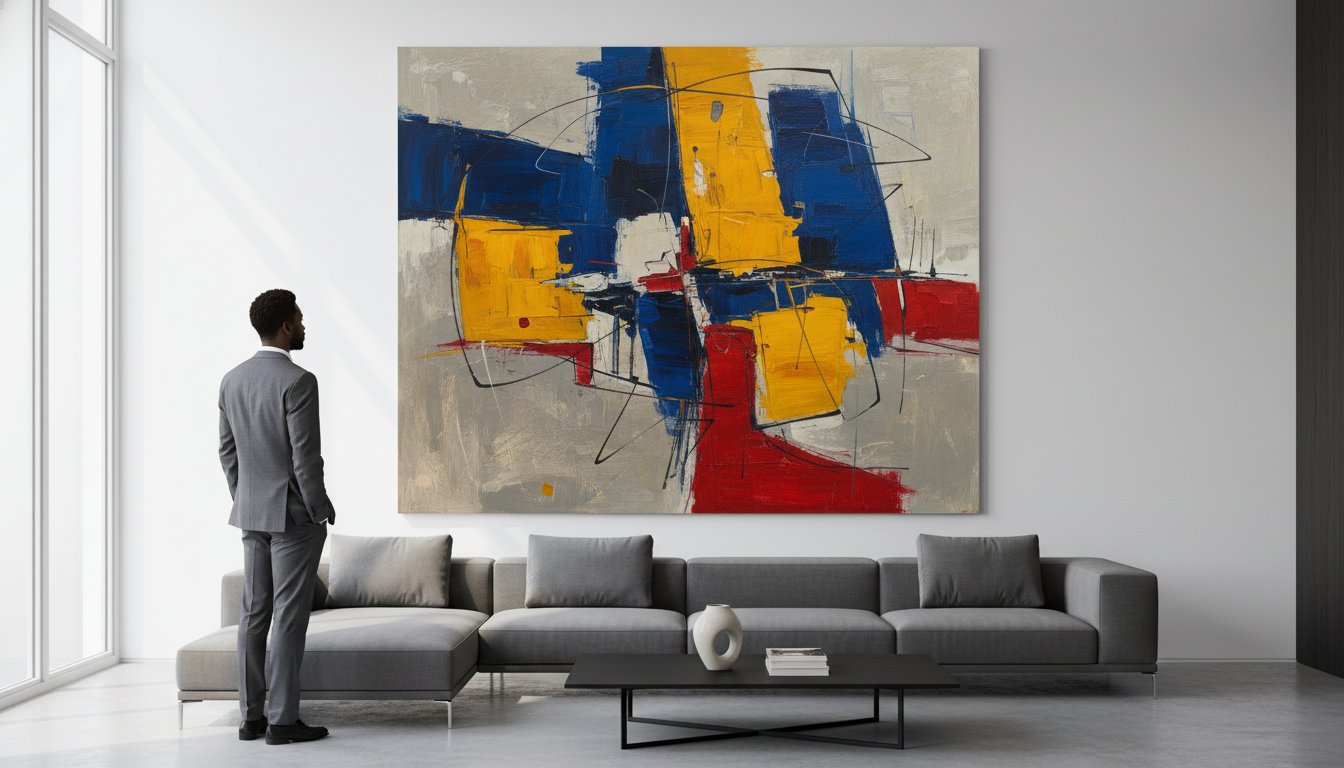
This is precisely why abstract art is so powerful in interior design. It doesn’t just match your sofa; it transforms the entire atmosphere of your space. A bold, energetic piece can become a stunning focal point, injecting life and personality into a minimalist room. A softer, more serene work can create a sanctuary of calm. The best famous abstract paintings do more than just decorate a wall-they tell a story without words and set the emotional tone for your home.
The Birth of a Revolution: Why Artists Broke with Reality
In the late 19th and early 20th centuries, art was undergoing a radical change. With the invention of photography, artists no longer felt the need to simply copy reality. Why paint a perfect portrait when a camera could capture it in an instant? This new freedom allowed them to explore the unseen world-the complex tapestry of human emotions, the rhythms of music, and deep spiritual ideas. Abstract art became a new frontier for ultimate creative expression.
Understanding the Language of Abstraction
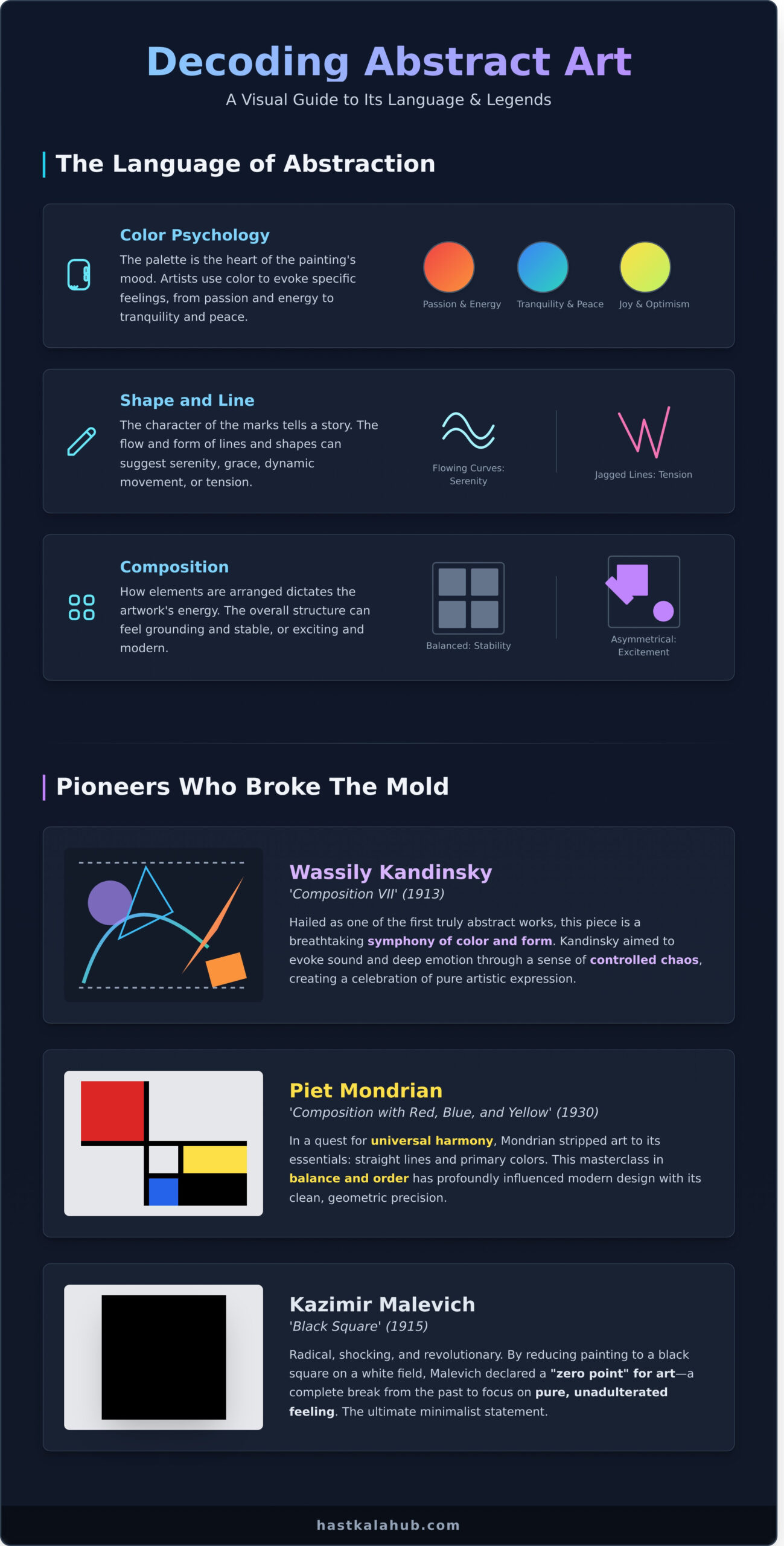
To truly appreciate abstract art, you must learn to read its unique language. The artist uses specific visual tools to communicate a feeling or idea, and understanding them will deepen your connection to any piece.
- Color Psychology: The palette is the heart of the painting’s mood. Vibrant reds and oranges can ignite feelings of passion and energy, while deep blues and soft greens evoke a sense of tranquility and peace.
- Shape and Line: The character of the marks tells a story. Soft, flowing curves often suggest serenity and grace. In contrast, sharp angles and bold, jagged lines create a feeling of dynamic movement and tension.
- Composition: How the elements are arranged dictates the artwork’s energy. A balanced, harmonious composition can feel grounding and stable, while an asymmetrical or chaotic one brings excitement and a chic, modern edge. Many famous abstract paintings master this balance to create their timeless appeal.
The Pioneers: Masterpieces That Broke the Mold
Before abstract art became a celebrated staple of modern decor, a handful of visionary artists dared to see the world differently. The early 20th century was a vibrant period of radical experimentation, where movements like Cubism and Suprematism shattered traditional rules. These pioneers didn’t just paint objects; they painted ideas, emotions, and rhythms. Their groundbreaking work created some of the most famous abstract paintings in history, laying a foundation that would eventually lead to even more dynamic styles and exploring what the Museum of Modern Art defines as The Power of Abstract Expressionism.
Wassily Kandinsky – ‘Composition VII’ (1913)
Often hailed as one of the first truly non-representational works, ‘Composition VII’ is a breathtaking symphony of color and form. Kandinsky masterfully orchestrates a sense of controlled chaos, aiming to evoke sound and deep emotion through his vibrant palette and swirling lines. This piece isn’t about what you see; it’s about what you feel. It’s a celebration of pure artistic expression, perfect for adding dynamic energy to a minimalist room.
Piet Mondrian – ‘Composition with Red, Blue, and Yellow’ (1930)
In a quest for universal harmony, Piet Mondrian stripped art down to its essential elements: straight lines and primary colors. This iconic composition is a masterclass in balance and order. Its clean, geometric precision has profoundly influenced modern design, fashion, and architecture. Hanging a print of this work introduces a sense of intentional structure and chic, intellectual style, proving that simplicity can be incredibly powerful.
Kazimir Malevich – ‘Black Square’ (1915)
Radical. Shocking. Revolutionary. Malevich’s ‘Black Square’ is the ultimate statement piece. By reducing painting to a black square on a white field, he declared a “zero point” for art-a complete break from the past and a focus on pure, unadulterated feeling. This bold work represents a new beginning, making it a powerful and thought-provoking addition for the modern home that embraces minimalism and conceptual depth.
Mid-Century Explosions: The Power of Abstract Expressionism
After World War II, the art world’s center of gravity shifted dramatically from Paris to New York. A new, confident American spirit gave rise to Abstract Expressionism-a movement defined by monumental scale, raw emotion, and a celebration of the creative act itself. These artists weren’t just painting objects; they were capturing pure feeling. This vibrant wave of creators redefined the very idea of What is Abstract Art?, splitting into two main paths: the dynamic energy of ‘action painting’ and the soulful contemplation of ‘color field’ painting.
Jackson Pollock – ‘Number 1, 1950 (Lavender Mist)’
Jackson Pollock became a cultural icon with his revolutionary ‘drip’ technique. Placing enormous canvases on the floor, he would move around them, pouring and flinging paint in a controlled yet free-flowing dance. This is ‘action painting’ at its peak. Lavender Mist isn’t a picture of something; it is the stunning record of Pollock’s physical movements-a complex web of energy, freedom, and intricate rhythm that channels pure creative impulse.
Mark Rothko – ‘No. 14, 1960’
In elegant contrast to Pollock’s frantic energy, Mark Rothko explored emotion through ‘color field’ painting. His works, like the sublime No. 14, 1960, feature large, rectangular blocks of shimmering, luminous color that seem to float on the canvas. Rothko’s goal was deeply spiritual. He wanted the viewer to stand close, to be enveloped by the color, and to have an intimate, personal, and profoundly emotional encounter with the work itself.
Willem de Kooning – ‘Excavation’ (1950)
Willem de Kooning masterfully bridged the gap between pure abstraction and figuration. Excavation is a whirlwind of creative force, with frantic brushstrokes and thickly layered paint that has been scraped away and reapplied. Glimpses of figures and forms emerge and disappear within the chaotic composition, perfectly capturing the frenetic, overwhelming pace of modern city life. It’s a powerful example of how famous abstract paintings can channel the pulse of an era.
Global Perspectives: Abstract Art Beyond Europe and America
When we think of famous abstract paintings, our minds often travel to 20th-century Paris or New York. But the revolutionary spirit of abstraction was a truly global conversation, with brilliant artists worldwide reinterpreting its principles through their own unique cultural lenses. This was not imitation; it was a vibrant, independent evolution of style, where heritage and modernism met in breathtaking new ways.
These artists prove that non-representational art can be deeply personal and culturally specific, drawing from ancient philosophies, spiritual traditions, and local aesthetics. It’s a powerful reminder that creativity knows no borders.
V. S. Gaitonde – ‘Untitled’ (1995)
Considered one of India’s foremost abstract painters, V.S. Gaitonde was a master of silence and contemplation. His work is not an explosion of energy, but a deep, meditative dive into luminous color. Inspired by Zen philosophy, he meticulously built up layers of paint, creating a profound sense of depth and inner light. His canvases are tranquil, textured worlds that invite you to pause and reflect, celebrating the beauty of quietude.
Hilma af Klint – ‘The Ten Largest, No. 7, Adulthood’ (1907)
Long before the men credited with pioneering abstraction, Swedish artist Hilma af Klint was channeling a new visual language. Inspired by spiritualism and the natural world, her work from 1907 is a testament to a visionary mind. ‘Adulthood’ bursts with vibrant, symbolic color and swirling biomorphic forms that represent the stages of life. Her rediscovery has rightfully rewritten art history, celebrating a woman artist who was truly ahead of her time.
From Gaitonde’s serene minimalism to af Klint’s cosmic energy, these global artists showcase the incredible diversity of abstract expression. This celebration of distinct, artisanal vision is the very spirit we cherish at Hast Kala Hub, where global traditions and modern design are woven together. Discover decor that tells a unique story, made with passion and a world of inspiration.
How to Choose and Style Abstract Art in Your Home
Feeling inspired by the energy and elegance of the world’s most famous abstract paintings? Now it’s time to bring that vibrant spirit into your own space. Choosing art can feel intimidating, but it’s a joyful process of self-expression. Forget rigid rules. The goal is to find a piece that elevates your home and makes you happy every time you see it. These simple guidelines will help you select and style abstract art with confidence.
Start with Emotion and Color
Before you begin your search, ask yourself: How do I want this room to feel? Are you aiming for a calm, serene sanctuary or an energetic, vibrant hub? Let that feeling guide your choice. Look for pieces with a color palette that either complements your existing decor for a harmonious look or introduces a bold, contrasting shade to create a stunning focal point. A single, powerful piece can define the entire mood of a room.
Consider Scale and Placement
The right size and spot can make all the difference. Proper placement ensures your art commands the attention it deserves and integrates beautifully with your furniture and architecture. Keep these tips in mind:
- Anchor the Room: A large-scale abstract painting creates a dramatic, high-impact statement. Hang it above a key piece of furniture like a sofa, headboard, or dining room buffet to ground the space.
- Create a Gallery Wall: A collection of smaller abstract pieces can add dynamic interest and personality. Mix and match sizes and orientations for a curated, eclectic vibe.
- Hang at Eye Level: For the best viewing experience, the center of the artwork should be approximately 57-60 inches from the floor.
Trust Your Instincts
Ultimately, this is the most important rule: buy what you love. You don’t need to be an art historian or understand the artist’s “meaning” to appreciate a piece. If a painting’s colors, textures, or forms resonate with you, that’s all that matters. Abstract art is a fantastic conversation starter, and the best pieces are the ones that speak directly to you. Your home is your story, and the art you choose is a vital chapter.
Celebrate in style with a piece that tells your story.
Celebrate Your Style: The Enduring Legacy of Abstract Art
From the revolutionary canvases of its pioneers to the explosive energy of the Abstract Expressionists, the journey of abstract art is a powerful testament to creative freedom. The legacy of these famous abstract paintings is not that they are complex, but that they invite us to feel, to interpret, and to see the world through a new lens. They prove that the most profound statements are often made not with perfect representation, but with pure color, form, and emotion. This is a spirit you can bring into your own home.
Now, it’s your turn to make a statement. You don’t need a museum-sized budget to own art that speaks to you. At Hast Kala Hub, our artisans-paradise is filled with unique, handmade pieces designed to bring vibrant energy to your space. Each canvas is a story of its own, made with passion and ready to become a part of yours.
Find an abstract painting made with passion. Explore our collection!
With secure payment, 100% risk-free shopping, and global shipping, we make it simple to bring breathtaking art right to your doorstep. Celebrate your unique style and transform your home today.
Frequently Asked Questions
What is the most famous abstract painting in the world?
Many celebrate Piet Mondrian’s Composition with Red, Blue, and Yellow (1930) as a pinnacle of abstract art. Its bold primary colors and stark black lines create a vibrant, balanced energy that feels eternally modern. This iconic piece broke new ground, showing how pure shape and color could express universal harmony. It remains one of the most influential and recognized abstract works, inspiring designers and artists worldwide.
Why is abstract art so expensive?
The value of abstract art comes from a blend of rarity, artist legacy, and historical importance. A piece by a master like Mark Rothko or Jackson Pollock is a one-of-a-kind artifact from a pivotal art movement. Its price reflects the artist’s influence, the artwork’s provenance, and the high demand from collectors who want to own a unique piece of cultural history. It’s an investment in pure, unfiltered creativity.
What is the difference between abstract and modern art?
Think of Modern Art as the main era and Abstract Art as a key style within it. Modern Art is a broad period (roughly 1860s-1970s) that broke from traditional rules. Abstract art is a specific approach that emerged during this time, focusing on non-representational forms, colors, and textures to convey emotion. So, while most early abstract art is modern, not all modern art is abstract.
How do I know if an abstract painting is ‘good’?
A “good” abstract painting is ultimately one that speaks to you! Look for a strong sense of composition, where your eye is guided around the canvas. Notice the artist’s confident use of color, texture, and line. Most importantly, does it evoke an emotion or a feeling? The best pieces create a vibrant mood and start a conversation, making them a truly personal and stylish statement in your home.
Can I mix abstract art with more traditional decor styles?
Absolutely! Pairing abstract art with traditional decor creates a chic and dynamic look. A bold, colorful abstract canvas hanging over a classic wooden mantel or an antique console table makes a powerful, confident statement. This elegant contrast bridges eras, infusing your space with modern energy. Replicas of famous abstract paintings are a perfect way to introduce this vibrant, trend-setting style into a more traditional setting.
Who is considered the father of abstract art?
Wassily Kandinsky is widely celebrated as the father of abstract art. The Russian painter was a pioneer who believed that colors and shapes could communicate emotions independently of real-world objects. Around 1910, he created some of the first purely abstract works, moving away from landscapes to express his “inner necessity” through vibrant, spiritual compositions. His bold vision truly set the stage for modern abstraction.



