
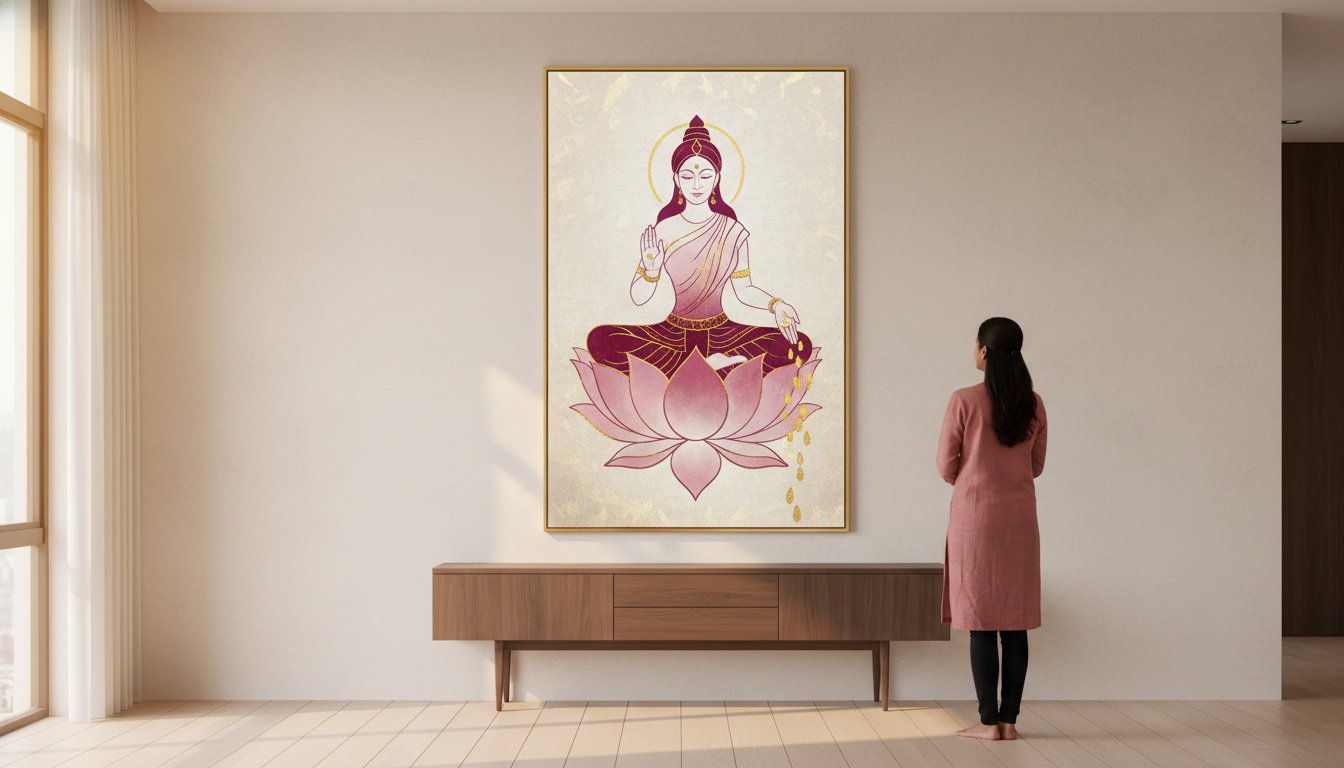
Have you ever felt drawn to the vibrant beauty of sacred art, wishing you could invite that energy into your home but feeling unsure where to start? It’s easy to be captivated by a stunning painting of a Hindu deity, yet feel lost in its rich, symbolic details. You want to create a space that feels abundant and spiritually alive, but you need the confidence to choose a piece that is both meaningful and respectful. This is especially true when welcoming the radiant energy of Goddess Lakshmi, the celebrated embodiment of wealth, fortune, and grace.
Forget dense, academic texts. This is your invitation to discover the elegant world of Lakshmi with clarity and joy. We will explore the powerful story behind her divine presence and decode the beautiful symbolism in her art-from the pristine lotus flower to the cascading gold coins. You will learn how to distinguish between different artistic styles and feel empowered to select the perfect painting to welcome her auspicious blessings, transforming your home into a sanctuary of prosperity and timeless style.
Key Takeaways
- Decode the rich symbolism in every element of a Lakshmi painting to deepen your appreciation for this sacred art.
- Explore the Ashta Lakshmi to discover the eight unique forms of wealth you can welcome into your life, beyond just material riches.
- Learn the ideal Vastu-aligned placement for a Lakshmi artwork to maximize the flow of positive energy and abundance in your space.
- Gain practical tips on selecting a portrayal of the goddess that best aligns with your personal aspirations for success and well-being.
Who is Goddess Lakshmi? The Embodiment of Fortune and Beauty
In the vibrant tapestry of Hindu deities, Goddess Lakshmi shines as a central and beloved figure, celebrated as the embodiment of all that is auspicious and desirable. She is the divine source of wealth, fortune, prosperity, and sublime beauty. With a gentle, lotus-like grace and a hand raised in blessing (Varada Mudra), her nature is purely benevolent. As the divine consort of Lord Vishnu, the Preserver, she represents the active, creative energy that brings abundance and light into the world. It is this radiant, life-affirming presence that makes a Lakshmi painting a cherished centerpiece in homes, inviting harmony, elegance, and success across the threshold.
Goddess of More Than Just Material Wealth
The prosperity that Lakshmi bestows transcends mere financial gain. Her blessings celebrate a holistic vision of abundance, enriching every facet of life and spirit. This complete fulfillment, known as Purna-Kamatva, includes:
- Spiritual Well-being: Inner peace, contentment, and a deeper connection to the divine.
- Joy and Fulfillment: The richness of strong family bonds, vibrant health, and genuine happiness.
- Success and Courage: The strength and wisdom to overcome adversity and achieve one’s goals with grace.
She reminds us that true wealth is a state of being-a life overflowing with purpose, love, and gratitude.
Lakshmi’s Role in the Hindu Trinity
While often celebrated independently, the role of Lakshmi is integral to the cosmic balance maintained by the Hindu Trinity. As the divine consort and shakti (energy) of Vishnu, the Preserver, the revered Goddess Lakshmi provides the power that enables him to sustain dharma (cosmic order) and harmony in the universe. Her presence is inseparable from his; whenever Vishnu descends to Earth in an avatar, she accompanies him to aid his mission. We see this celebrated in the timeless stories of Sita with Rama and Radha with Krishna. This divine partnership underscores her essential role in nurturing, protecting, and beautifying the world, making her a symbol of cosmic stability and grace.
Decoding the Rich Symbolism in Lakshmi’s Iconography
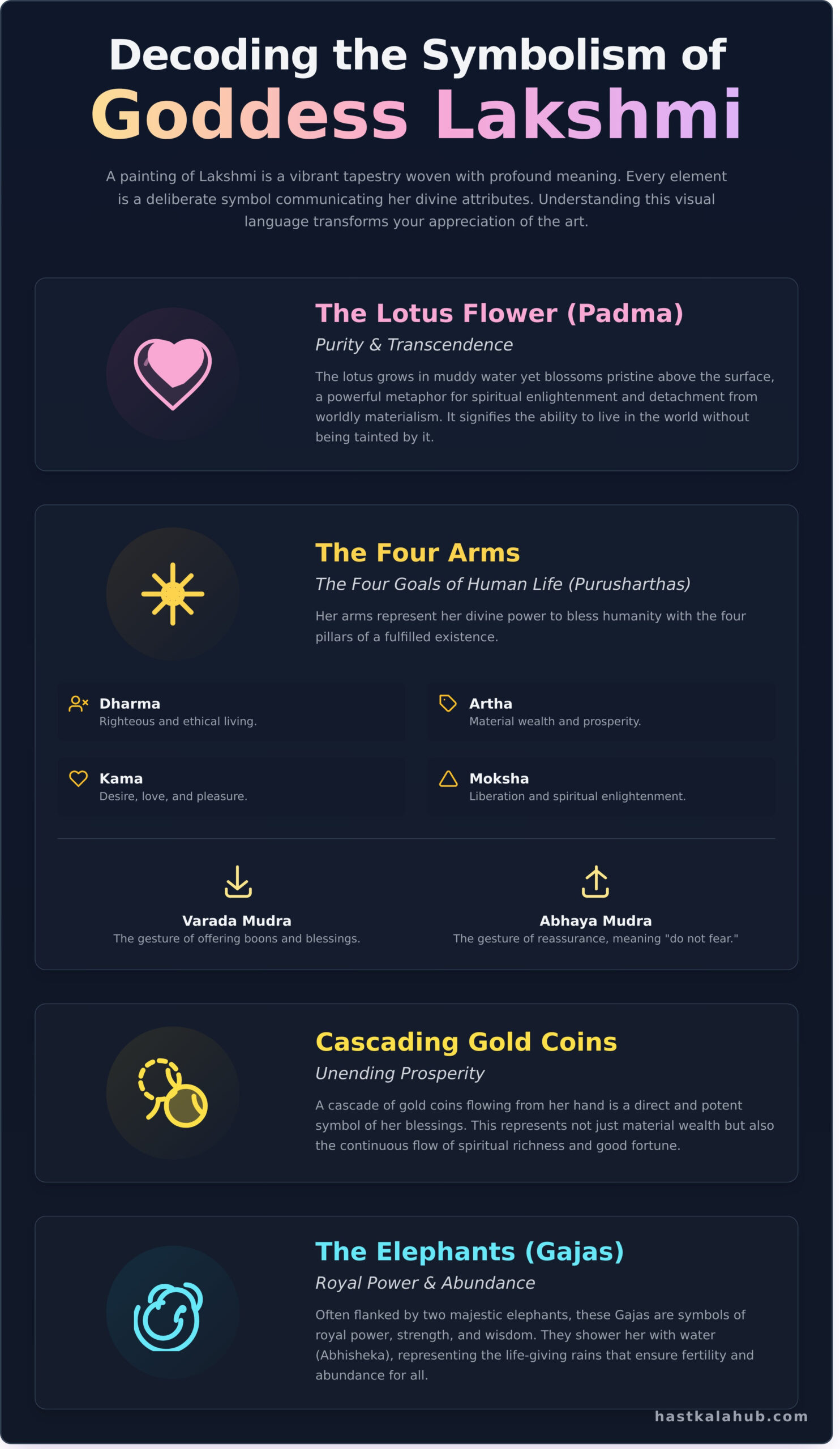
A painting of Lakshmi is more than a beautiful piece of decor; it is a vibrant tapestry woven with profound meaning. Every element, from the flower she sits upon to the gesture of her hands, is a deliberate symbol communicating her divine attributes of fortune, purity, and spiritual grace. Understanding this visual language transforms your appreciation of the art, creating a deeper connection to the energy it brings into your home. The consistency of these symbols across different eras is a testament to their power, a fact well-documented in historical collections exploring Lakshmi’s representation in art.
The Lotus Flower: Purity and Transcendence
The goddess is almost always depicted seated or standing gracefully upon a fully bloomed lotus. This is no mere artistic choice. The lotus grows in muddy water yet blossoms pristine and beautiful above the surface, serving as a powerful metaphor for purity, spiritual enlightenment, and detachment from worldly materialism. It signifies the ability to live in the world without being tainted by it. This intimate connection is why she is also celebrated by names like Padma (lotus-one) and Kamala.
The Four Arms: The Four Goals of Human Life
Her four arms represent her divine power to bless humanity with the four purusharthas, or goals of human life: Dharma (righteous living), Artha (material wealth), Kama (desire), and Moksha (liberation). Her front right hand is typically shown in the Varada mudra, palm open to offer boons and blessings. Her front left hand is often in the Abhaya mudra, a gesture of reassurance that says, “do not fear.” Her two back hands hold lotus buds, symbolizing beauty and the unfolding of spiritual consciousness.
Gold Coins and Elephants: Symbols of Abundance
A cascade of gold coins is often seen flowing from her lower hand, a direct and potent symbol of unending prosperity. This represents not just material wealth but also spiritual richness. Flanking her, you will often find two majestic elephants, known as Gajas, showering her with water from ceremonial vessels. These elephants are symbols of royal power, strength, and wisdom. Their act of showering her (Abhisheka) also represents the life-giving rains that ensure fertility and abundance for all.
The Ashta Lakshmi: Exploring the Eight Divine Forms of Wealth
While Lakshmi is universally celebrated as the goddess of prosperity, Hindu tradition reveals a deeper, more nuanced understanding of wealth through her eight divine forms-the Ashta Lakshmi. Each magnificent manifestation presides over a specific type of abundance, proving that true prosperity enriches every aspect of life, from our minds to our families.
Artists and artisans, inspired by this profound concept, often create vibrant depictions of these individual forms. Understanding them allows you to choose a piece of art that not only beautifies your space but also aligns with your deepest intentions and aspirations. Celebrate your goals by inviting the right divine energy into your home.
From Knowledge to Progeny: A Wealth for Every Need
The concept of Ashta Lakshmi beautifully illustrates that wealth is multi-faceted. It is courage, knowledge, and family, just as much as it is material gain. Our curated collections often feature these powerful forms, each telling a unique story of abundance.
- Dhana Lakshmi: The most familiar form, she is the giver of material riches, gold, and monetary fortune. Her presence invokes financial stability and success.
- Vidya Lakshmi: As the bestower of knowledge and artistic skill, her energy is perfect for a study, library, or creative studio, blessing the space with wisdom and inspiration.
- Santana Lakshmi: This compassionate form presides over the gift of children and family well-being. She is the patroness of progeny, nurturing happy and healthy family life.
- Gaja Lakshmi: Flanked by majestic elephants, this is one of the most ancient and revered representations of the Goddess Lakshmi, symbolizing royal power, authority, and the wealth of livestock.
Identifying Ashta Lakshmi in Art
Recognizing the different forms of Lakshmi in a painting adds a wonderful layer of meaning to your art selection. Each form has distinct iconography-visual cues that reveal her identity and blessings. Look for the intricate symbols and vibrant colors that tell her divine narrative.
For example, Dhairya Lakshmi, the embodiment of courage, is often depicted in brilliant red and carries an array of weapons to grant inner strength. Dhanya Lakshmi, the goddess of agricultural wealth, holds sheaves of paddy, symbolizing a bountiful harvest. The objects she holds, the color of her attire, and the creatures accompanying her are all clues. When you explore the stunning Lakshmi paintings at Hast Kala Hub, take a moment to notice these divine details and choose the form whose blessings resonate most with you.
Choosing a Lakshmi Painting for Your Home: A Guide to Art and Placement
Understanding the symbolism of Goddess Lakshmi is the first step; bringing her divine energy into your home is the next. Choosing a piece of art is a personal journey that blends spiritual intention with your unique aesthetic. A painting of Lakshmi is more than decor-it’s an invitation for prosperity, harmony, and positive vibrations to fill your space. Let’s explore how to select the perfect piece to create a home that feels both beautiful and blessed.
Popular Artistic Styles: From Traditional to Contemporary
The beauty of sacred art is its diverse expression. For a touch of timeless opulence, consider a Tanjore painting, renowned for its rich colors, 22-karat gold foil, and embedded semi-precious gems. In vibrant Pichwai art, she is often depicted alongside Shrinathji, celebrating devotion and abundance. For modern interiors, an abstract or contemporary interpretation offers a chic, minimalist way to honor her energy. The most important rule? Choose a style that truly speaks to you and complements your home’s personality.
Vastu Shastra: The Best Placement for Prosperity
Vastu Shastra, the ancient Indian science of architecture, guides us on how to place sacred art to maximize its positive influence. To welcome wealth and well-being, follow these simple principles:
- Ideal Direction: Place your painting on a wall in the north or east direction of your home or office. The north is governed by Kuber, the god of wealth, making it a powerful zone for a Lakshmi artwork.
- Elevated Position: Always hang the artwork at a respectful height, ideally at eye level. Avoid placing it near the floor or in areas like bathrooms or basements.
- Welcome at the Entrance: Hanging a painting of the goddess near your main entrance is a beautiful way to welcome her energy into your home every day.
What to Look for in a Quality Lakshmi Painting
A truly exceptional piece of art will radiate positive energy. When selecting your painting, pay attention to the details that bring the goddess to life. Look for a serene, benevolent, and pleasant facial expression, as this sets a peaceful tone. The colors should be vibrant and joyful, reflecting the abundance she represents. Finally, ensure key symbols like the lotus flower, gold coins, and her divine elephants are depicted with clarity and skill. Ready to find your masterpiece?
Celebrate in style with a divine Lakshmi painting from our collection.
Celebrate Prosperity with Divine Art
From the rich symbolism in her iconography to the diverse blessings of her eight forms, we have seen how Goddess Lakshmi embodies grace and abundance. More than just a deity, she represents a flow of positive energy that can be welcomed into our lives. Choosing the right piece of art and placing it with intention is a powerful way to transform your home into a sanctuary of fortune and well-being.
At Hast Kala Hub, we believe in celebrating this divine connection. Our vibrant collection features authentic artisanal paintings from India, where timeless tradition meets chic, modern style. Each piece is made with passion, ready to bring its unique energy to you. With worldwide shipping, this sacred beauty is just a click away.
Discover our collection of exquisite Lakshmi paintings and invite prosperity into your home.
May your space be forever blessed with light, luck, and limitless fortune.
Frequently Asked Questions
What is the difference between Goddess Lakshmi and Goddess Saraswati?
Goddess Lakshmi is the divine embodiment of wealth, prosperity, and fortune, often depicted with gold coins and seated on a lotus. In contrast, Goddess Saraswati represents knowledge, music, learning, and the arts, typically shown with a veena and a book. While both are revered goddesses who bring immense blessings, Lakshmi governs material and spiritual abundance, while Saraswati is the patron of wisdom, creativity, and the pursuit of knowledge. Both bring a unique and powerful energy to your home.
What is the story of Lakshmi’s birth from the churning of the ocean?
The celebrated story of Lakshmi’s birth comes from the Samudra Manthan, or the Churning of the Ocean. In this divine event, gods and demons churned the cosmic ocean to obtain the nectar of immortality. From the depths emerged many celestial treasures, and most radiant among them was Goddess Lakshmi. She appeared seated on a fully bloomed lotus, her divine presence bringing instant fortune, beauty, and auspiciousness to the world and all who witnessed her arrival.
Is it appropriate to give a Lakshmi painting as a gift?
Absolutely! A Lakshmi painting is a truly elegant and thoughtful gift. It is more than just decor; it is a beautiful blessing for prosperity, success, and well-being. Gifting a depiction of the goddess is perfect for special occasions like housewarmings, weddings, new business launches, or the festival of Diwali. It’s a stylish and culturally rich way to wish someone good fortune and celebrate their new chapter with an abundance of positive energy.
How is Lakshmi celebrated during the festival of Diwali?
During Diwali, the festival of lights, Goddess Lakshmi is the central deity of worship. Homes are meticulously cleaned and decorated to welcome her, symbolizing a fresh start. Families light countless diyas (oil lamps) and create vibrant rangoli designs at their entrances to guide her path and illuminate her way. The main event is the Lakshmi Puja, a special prayer ceremony performed in the evening to invite her blessings of wealth and happiness for the year ahead.
Can I keep a Lakshmi painting or statue in my office or place of business?
Yes, placing a Lakshmi painting in your office is a wonderful practice for inviting success and financial growth. Her presence is believed to attract positive energy, new opportunities, and prosperity. For the best results, place your Lakshmi artwork in a clean and respected area, ideally on a north or east-facing wall. This honors her divine energy and sets a powerful intention for welcoming abundance and success into your professional space.
What colors are most associated with Goddess Lakshmi in art?
In traditional art, Goddess Lakshmi is most often celebrated in a vibrant palette of red and gold. Red, particularly in her sari, symbolizes auspiciousness and divine energy, while gold represents wealth, luxury, and spiritual purity. You will also frequently see shades of pink, reflecting the lotus flower she is seated upon, which signifies beauty and enlightenment. These rich, elegant colors make a Lakshmi painting a stunning and meaningful addition to any decor.



