
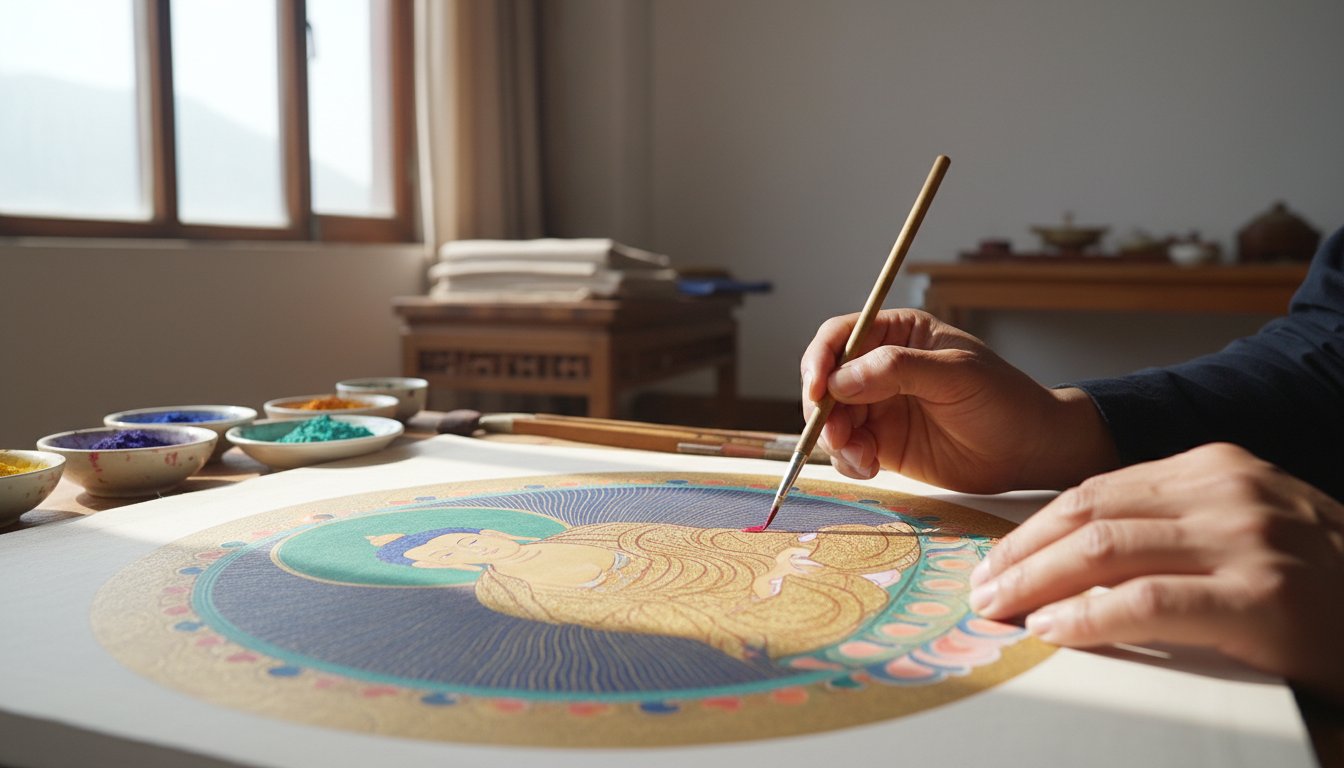
Ever been captivated by the vibrant colors and intricate details of a Tibetan masterpiece, only to feel a little lost in its profound symbolism? You’ve discovered the world of thangka painting, a sacred art form where every brushstroke tells a story of devotion and enlightenment. It’s far more than decoration; it’s a window into a rich spiritual heritage, an art form made with passion and incredible skill.
But navigating this world can feel intimidating. How do you distinguish an authentic, soul-infused piece from a simple print? And what is the most respectful way to display and care for such a sacred work? In this guide, we celebrate this timeless tradition by demystifying its beautiful imagery. We’ll empower you to appreciate the incredible devotion of its creators and help you find a meaningful piece of art that serves as both a stunning focal point and a source of profound inspiration for your space.
The Soul of Tibetan Art: What Exactly is a Thangka?
Step into a world of divine beauty and profound meaning. A thangka is far more than a painting; it is a sacred scroll, a ‘recorded message’ that serves as a vibrant portal to the enlightened mind. Originating in the Himalayan regions of Tibet and Nepal around the 11th century, this complex art form, known as Thangka painting, serves a profound dual purpose. For practitioners, it is a powerful meditation tool, a visual guide to complex spiritual concepts and deities. For learners, it is a teaching aid, illustrating the life of the Buddha, philosophical principles, and cosmic mandalas.
Traditionally designed for portability, these scroll paintings could be easily rolled up and transported by nomadic monks and traveling teachers, carrying lessons of wisdom and compassion across vast landscapes. Each one is a celebration of faith, artistry, and devotion, made to inspire and elevate the spirit.
The Art of Enlightenment: Materials and Meticulous Process
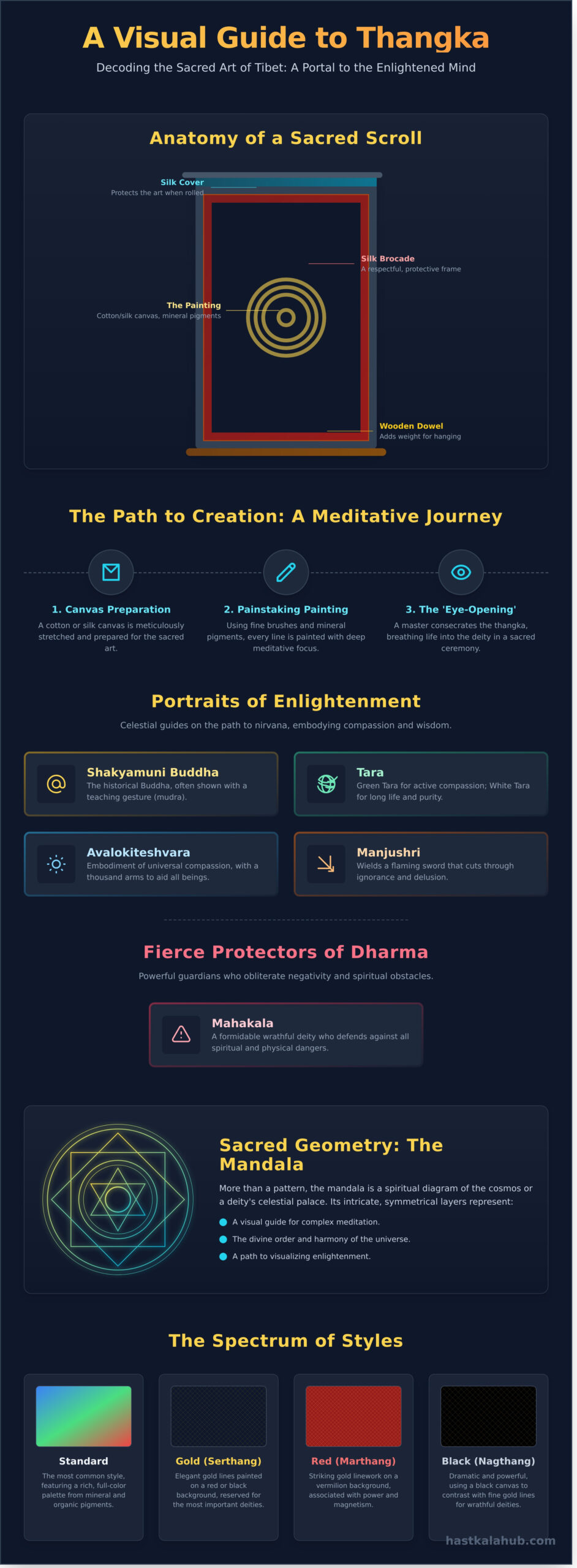
The creation of this sacred art is an act of deep meditation, a process infused with prayer and precision. The journey begins with a cotton or silk canvas, meticulously prepared and stretched. Artists use traditional pigments ground from minerals and organic materials, creating a palette of rich, symbolic colors designed to last for centuries. With fine brushes, every line is painted with painstaking detail, a testament to the artist’s discipline. The process culminates in the sacred ‘eye-opening’ ceremony, where a master consecrates the artwork, breathing life into the deity depicted.
More Than a Frame: The Significance of the Silk Brocade
A thangka is never complete without its traditional silk brocade mounting. This elegant textile border is more than just a frame; it is a mark of respect that protects and honors the sacred image within. The colors and patterns of the brocade are often symbolic, complementing the central deity and enhancing the painting’s spiritual energy. A wooden dowel at the bottom adds weight for hanging, while a silk cover protects the painted surface when the scroll is rolled for storage, preserving its divine message for generations.
Decoding the Divine: Common Symbols and Figures in Thangkas
A thangka is more than a beautiful painting; it is a sacred map to enlightenment. This vibrant art form uses a rich visual language known as iconography, where every color, posture, and object is infused with profound meaning. These are not mere illustrations but are considered living manifestations of enlightened qualities. The creation and veneration of this sacred Tibetan art is a spiritual practice in itself, connecting the artist and viewer to the divine. To truly appreciate a thangka, one must learn to decode its divine cast of characters and symbols.
Portraits of Enlightenment: Buddhas and Bodhisattvas
At the heart of many thangkas are serene figures who embody compassion and wisdom. These are the celestial guides on the path to nirvana, each representing a unique aspect of the enlightened mind.
- Shakyamuni Buddha: The historical Buddha, Siddhartha Gautama, often depicted with his hand raised in a teaching gesture (mudra), sharing his wisdom with the world.
- Tara (Green and White): A beloved female Bodhisattva. Green Tara represents active compassion and protection, while White Tara symbolizes long life and purity.
- Avalokiteshvara: The embodiment of universal compassion, famously depicted with a thousand arms to aid all suffering beings.
- Manjushri: The Bodhisattva of transcendent wisdom, he wields a flaming sword that cuts through ignorance and delusion.
Wrathful Deities: Fierce Protectors of Dharma
While their appearance-with sharp fangs, multiple limbs, and fiery halos-may seem menacing, these figures are powerful guardians. Their ‘wrath’ is not anger but the fierce, energetic power needed to obliterate negativity and destroy the obstacles that prevent spiritual progress. They are the ultimate protectors of the teachings (Dharma). A prominent example is Mahakala, a formidable deity who defends against all spiritual and physical dangers.
Sacred Geometry: Understanding Mandalas
The mandala is one of the most mesmerizing symbols in Tibetan Buddhism. Far from being just a geometric pattern, it is a spiritual diagram of the cosmos or the celestial palace of a specific deity. Each intricate layer and symmetrical detail serves as a guide for complex meditation practices, helping the practitioner visualize the path to enlightenment. Its perfect structure represents balance, harmony, and the divine order of the universe.
The Spectrum of Styles: Exploring Different Types of Thangka
Step into the vibrant world of Tibetan art, and you’ll discover that the thangka is not a single, monolithic style. It is a universe of diverse artistic expressions, each with its own unique purpose, lineage, and visual language. From radiant, full-color masterpieces to dramatic, minimalist compositions, the variety is a celebration of spiritual devotion and creative mastery. Understanding these styles helps you appreciate the profound depth and intention behind every piece.
Color & Lineage: Gold, Red, and Black Thangkas
The color palette of a thangka is its soul, setting the emotional and spiritual tone. While many are bursting with color, some of the most revered styles are defined by their elegant and powerful use of line and precious metals.
- Standard Thangkas: These are the most widely recognized style, featuring a rich, full-color palette. Artists use mineral and organic pigments to depict deities, mandalas, and spiritual masters in a world that mirrors the vibrancy of enlightened consciousness.
- Gold Thangkas (Serthang): The epitome of elegance, a Serthang features shimmering gold lines painted on a red or black background. This luxurious style is reserved for depicting the most important deities and celebrating the preciousness of their teachings.
- Red Thangkas (Marthang): Using a striking vermilion or crimson background, a Marthang features the same delicate gold linework. This powerful color is often associated with specific deities and energies of power and magnetism.
- Black Thangkas (Nagthang): Perhaps the most dramatic, the Nagthang uses a deep black canvas to create a powerful contrast with fine gold lines. This style is typically used for wrathful or protective deities, where the darkness emphasizes the fierce compassion of the subject. For those looking to delve deeper into identifying these visual cues, Christie’s offers an excellent a guide to thangka paintings that explores their iconography.
Beyond the Brush: Thangkas of Fabric and Print
The artistry of the thangka extends beyond painted canvas, embracing the rich traditions of Tibetan textile work. These fabric-based creations offer a different texture and dimension to the sacred art form.
- Appliqué Thangkas: Instead of paint, these masterpieces are created by meticulously cutting and stitching together pieces of colored silk and brocade. This technique results in a bold, graphic style with a stunning three-dimensional quality.
- Embroidered Thangkas: A testament to patience and precision, these are created entirely with fine silk threads. The artist uses countless stitches to “paint” the image, achieving incredible detail and a soft, luminous texture.
- Printed Thangkas: An older and more accessible form, these were created using woodblock prints on paper or cloth. They played a crucial role in making sacred images and teachings widely available to practitioners.
Bringing a Thangka Home: Choosing, Displaying, and Care
Understanding the profound history and intricate creation of a Thangka is just the beginning. The journey truly deepens when you invite this sacred art into your own home, transforming a space with its spiritual energy and aesthetic grace. More than just decor, owning a piece is an opportunity to connect with centuries of tradition and bring a source of peace, inspiration, and vibrant beauty into your daily life. It’s about celebrating artistry and finding a piece that speaks to your spirit.
How to Choose a Thangka That Resonates with You
Choosing your first piece is an intuitive and personal experience. Begin by exploring the symbolism. Does the story of a particular deity like the compassionate White Tara or the powerful Manjushri resonate with your personal journey? Next, assess the quality. A masterpiece will feature precise, fine lines, intricate details, and a rich, balanced color palette. But above all, trust your intuition. The right thangka will evoke a feeling of connection and peace. Explore our collection of handcrafted art to elevate your space.
Displaying Your Thangka with Respect and Style
A Thangka is a spiritual object and should be displayed with intention and respect to honor its sacred nature. Elevate your art and preserve its beauty by following these simple guidelines:
- Choose a clean, high, and respected place in your home, such as a meditation space, living room, or study.
- Avoid hanging the art in bathrooms, low areas, or near the floor where it might be disrespected or damaged.
- Protect the delicate mineral pigments from direct sunlight and harsh artificial light to prevent fading over time.
- Consider professional framing with UV-protective glass to best preserve the silk brocade and painted surface.
Preservation and Care: Keeping Your Sacred Art Vibrant
Proper care ensures your sacred art remains a vibrant centerpiece for generations. These preservation tips will protect your investment and honor the artist’s meticulous work:
- Keep the artwork in a dry, stable environment to prevent moisture from damaging the canvas and pigments.
- If dusting is necessary, use only a very soft, dry brush and apply the gentlest pressure.
- If your piece is unframed, always roll it carefully with the painted image facing outwards to prevent cracking.
- When handling the piece, hold it by the brocade borders or the wooden dowel, never touching the painted surface itself.
By choosing thoughtfully and caring for your piece with mindfulness, your artwork will become more than an object-it will be a cherished source of inspiration and tranquility.
Celebrate the Divine: Your Journey with Thangka Art
A thangka is far more than a decorative piece; it is a sacred window into Tibetan spirituality, a vibrant narrative woven with divine figures and profound symbolism. We’ve explored how each color, deity, and pattern tells a story, and how different regional styles offer unique expressions of this ancient practice. Understanding this artistry transforms the act of viewing into a meditative experience. Bringing one into your home is an invitation to connect with centuries of devotion and masterful skill.
Ready to bring this profound energy into your own space? At Hast Kala Hub, we are dedicated to connecting you with the rich heritage of artisanal craftsmanship. Our curated collection of art is a testament to this commitment, featuring vibrant, soul-stirring pieces that are truly ‘Made with passion’. Each painting is selected to bring your walls to life with color, story, and spirit. Celebrate artistry and tradition. Discover unique, handcrafted paintings at Hast Kala Hub.
Let a piece of sacred history illuminate your home and inspire your spirit.
Frequently Asked Questions About Thangka Art
What is the difference between a Thangka and a Mandala?
A Thangka is a broad category of Tibetan Buddhist scroll painting, often depicting a deity or spiritual scene. A Mandala, however, is a specific type of sacred art-a complex, geometric diagram representing the cosmos or a divine palace. While a Mandala can be the central subject of a Thangka painting, not all Thangkas feature a Mandala. Think of “Thangka” as the canvas and style, and a “Mandala” as one possible, powerful subject.
Are Thangka paintings always religious?
Yes, authentic Thangka paintings are inherently religious and sacred. Each one is a piece of devotional art, created as a spiritual practice. They serve as visual aids for meditation, prayer, and teaching, depicting Buddhist deities, enlightened masters, or cosmic diagrams. The entire process, from preparing the canvas to applying the final gold details, is steeped in ritual and intention, making every piece a conduit for spiritual energy and learning.
How much does an authentic, hand-painted Thangka cost?
The cost of a hand-painted Thangka varies widely, reflecting the artist’s skill, size, and materials. A smaller, simpler piece from a skilled student may start around a few hundred dollars. However, a large, master-quality painting with intricate details, extensive 24K gold work, and finely ground mineral pigments can cost several thousand dollars or more. Each price point represents a different level of devotion, time, and artistic mastery invested in the sacred work.
Can anyone own a Thangka, or is it only for Buddhists?
Absolutely not! While Thangkas are rooted in Buddhist tradition, their profound beauty and exquisite craftsmanship can be appreciated by anyone. Owning a Thangka is a celebration of sacred art and ancient culture. We believe these stunning pieces are for all who are drawn to their spiritual depth and artistic elegance. We simply encourage displaying them in a place of respect, such as a high, clean area in your home, to honor their cultural origins.
How can you tell if a Thangka is a genuine painting versus a print?
To distinguish a genuine painting from a print, look closely at the details. An authentic thangka will show subtle, fine brushstrokes and the rich texture of hand-ground mineral pigments on a cotton or silk canvas. Prints often appear flat, glossy, and may reveal a uniform dot-matrix pattern under magnification. A true hand-painted piece feels alive with the artist’s touch, possessing a unique character and depth that a mechanical reproduction simply cannot replicate.
What is the most famous Thangka painting?
While many Thangkas are revered, one of the most famous is the gigantic appliqué Thangka of Jampa (Maitreya) Buddha at Tashi Lhunpo Monastery in Tibet. Unfurled only during the annual Sertang festival, its immense scale is breathtaking, covering a massive hillside. This “Gos-sku” or giant silk appliqué thangka is a spectacular example of communal devotion and artistry, drawing thousands of pilgrims who come to witness its grandeur and receive blessings.



